
The Problem
A government agency needed a project management system: not Microsoft Project, but a business information system to manage their functional projects. The overall scope included projects, staff,
deliverables, assignments, status reports, travel and expenses, client organizations and their staff, and the like. So the agency hired a contractor to come in and do a requirements analysis and
build a business information system. The requirements analysis was standard fare: meet with management, meet with functional experts, and meet with technical staff. Everybody was interviewed and
the requirements document filled several volumes. Everyone was happy.
The contractor took the requirements document away and implemented the business information system. After about a year of detailed design, coding, unit testing, and system testing, the business
information system was delivered to the government agency. The government agency shrieked in horror. What had the contractor done? That is not what the agency had said. Not what they had wanted.
How could this happen? The contractor was promptly fired.
Since this clearly had to be an aberration, a new contractor was hired. The new contractor met with management, met with functional experts, and met with technical staff. Everybody was interviewed
and the requirements document filled several volumes. Everyone was happy.
The contractor took the requirements document away and implemented the business information system. After about a year of detailed design, coding, unit testing, and system testing, the business
information system was delivered to the government agency. The government agency shrieked in horror. What had the contractor done? That is not what the agency had said. Not what they had wanted.
How could this happen? The contractor was promptly fired.
Since this clearly had to be an aberration, a new contractor was hired. Now to save the readers time, just go to back to the start of this cycle and read it again: two more times.
An epiphany then happened to the government agency. Since all the contractors were using the same data processing and implementation technology infrastructure to build the business information
system, it had to be the fault of the underlying technology infrastructure. The next step was to try to terminate and/or replace the underlying technology infrastructure. At that point, the
technology vendor brought in a consultant to completely evaluate the situation. The cycles of requirements through failure were examined to determine what went wrong. A classic methodology was
used, and so it was presumed that there would be a classic result. Actually, there was.
After the study, a meeting was called by the consultant with the government agency’s heads. The agency was eager to know not only what went wrong but who to blame. The answer was a shock. It
was the agency that was at fault, not the contractors. Of course, the agency angrily protested the findings. The consultant carefully went through the requirements-failure cycles and showed that
during every cycle the perception of what the problem was and, therefore, what the solution should be had changed.
It was not a case of whether the contractor got the requirements right. Rather, it was a case of the government agency not knowing what requirements it actually wanted. When the contractor talked
to different government staff, the answers were different not just from one staff member to another, but from previous answers provided by the same government staff member over the different
cycles. The objective, a successfully developed business information system, was impossible to achieve.
What to do? It was suggested to the government agency that they create their own detailed specification of what needed to be accomplished. The agency countered, “That’s the
contractor’s responsibility!” The consultant indicated that if four different contractors couldn’t create the “just right” specification, it was not the
contractor’s fault. The agency asked what it should do. The consultant suggested that a week-long workshop be conducted with agency staff to derive the requirements. The agency agreed. The
consultant asked the agency head for the names of the staff that absolutely were too important to be on the team. A list was immediately produced. The consultant said, “These are the names of
the individuals that must participate.” The agency head’s response was not “printable.”
The final agreement was this. A workshop would be conducted that would cause the creation not only of the specifications of the business information system to be produced, but also a prototype as
the specification’s proof. Further, the specifications were to be stored in an early version of the Whitemarsh Metabase so that the repository could be used in the subsequent full
implementation contract as the key reference point for the specification of what needed to be implemented. Finally, the process was required to iterate the requirements via the prototype
demonstrations until complete.
The workshop was conducted over five full days. There were four agency teams of four individuals each along with one information technology person per team. Each team lead had to be a functional
expert. Additionally, the team lead was instructed that the information technology person was to act solely as the team’s scribe in creating the metadata. If the information technology person
got out of hand, it was suggested to the team lead that they could to use duct-tape to silence the information technology person. A stick was also provided.
At the end of the week, the specification, the metadata and a high-level prototype were complete. The agency’s information technology department took the result and increased it with one or
two more levels of detail, including evolving the prototype. The full implementation contract was let and the system was developed, tested, and accepted by the agency.
The Problem from Requirements Changes
The United States Government’s General Accountability Office (GAO) has been studying information technology projects for a number of years. A review of United States General Accountability Office studies of why business information systems fail shows that new requirements so commonly crop up during the business
information systems development phase that this must be considered intrinsic to the software development life cycle as currently practiced. This phenomenon is the root cause of a preponderance of
these GAO-identified reasons for failure.
The new problems that arise when new requirements are uncovered during development fall into two categories: database design changes and software changes.
Significant database design changes often result from an insufficiently data-driven methodology through which the database is initially designed. Experience has shown that very high quality
database designs created through a data-driven methodology commonly return many times their design cost in reduced software development and evolution costs.
Software changes result from database design changes and also from process logic changes. Database design changes can be largely eliminated through the use of a quality database design methodology.
The onerous effects of process logic changes can be dramatically affected through the use of object-oriented analysis, design and programming techniques employed within the environment of business
information system generators.
A key strategy to minimize the negative impact of software changes is “code-generation,” that is, through a business information system generator. It is a software system that takes in
metadata specifications that have been created through the Metabase or other tools such as data modeling tools, and outputs the actual production-ready business information system. Business
information system generators have evolved greatly in the last 20 years and should be used in almost all situations. Clarion is a business information system generator.
A review of eight GAO studies mentioned earlier in this article clearly shows that the main reasons why business information systems fail has nothing to do with information technology. Rather, the
failures reside outside the sphere of information technology control. Nevertheless, information technology must work with the enterprise in the creation of a knowledge worker environment that
enables information technology to be successful. Such an environment would be win-win all the way around. In support of that goal, this article presents the following:
- COTS Is Not the Solution
- IT Environmental Prerequisites for Success
- The 9-step Approach
- The Payoff
- Summary
Before presenting this 9-step approach in any detail, a fundamental objection to this entire approach must be addressed. It has become painfully clear that some organizations try to avoid the
problem of underdeveloped or immature requirements by buying commercial off-the-shelf software (COTS). COTS, if improperly procured, may exacerbate this problem, not solve it.
COTS Is Not the Solution
Commercial off-the-shelf software (COTS) is not the solution. When COTS is purchased, what is actually being procured is software based on somebody else’s requirements analysis. Was that
analysis sufficient? Was it comprehensive? Did it match the organization’s real needs? If any of the answers is no, then buying COTS could produce a bad result for four reasons.
- Any business information system built on top of inadequate requirements causes an unsuitable COTS system to be selected and installed. The software will have been purchased. Staff will have
been trained. Hardware will have been procured. Data will have been converted. Only after production use has begun will it be known that it was the wrong solution. Fixing that problem requires
either abandoning the purchase, training, hardware, and data conversion, and beginning the process all over again, or convincing the users that their real requirements, which are only starting to
be discovered through system use, aren’t all that important or necessary. The first alternative is very expensive, and the second is quite unacceptable. - Changing COTS installed software ranges from difficult and expensive to impossible. Once changed, some COTS becomes custom software that, subsequently, is both difficult and expensive to change
to the next COTS version. - How would you know if the COTS system is based on inadequate requirements if a thorough requirements analysis hasn’t been performed? Without doing the 9-step approach, the probability of
having the right requirements will be very low. The risk will be very high. - Because the acquired software is COTS, the procuring organization now lacks both the capabilities and the tools to make its own software modifications. Rather, the organization’s mission
is accomplishable only when and if some outside vendor changes the COTS system. If the initial requirements analysis either wasn’t done or was done in a cursory manner, the
organization’s mission accomplishment may be fatally impacted.
If an organization wishes to purchase COTS, it is because of the four reasons cited above that the 9-step approach, albeit modified, is even more essential. During Step 8, instead of actually
“building” the software, the organization takes the five critical elements that result from this approach (Missions, Organizations, Functions, Database Design, and Validated Prototype)
and wraps all five into a request for proposal and issues it to a potential set of vendors. What will be given to the potential vendors is a highly refined and validated set of requirements, and
what will come back from the vendors will be a COTS proposal and software system that matches the “real” requirements.
IT Environmental Prerequisites for Success
There are essentials for business information system development success that return many times the cost. While business information systems can be implemented without these essentials, they cannot
be accomplished in an integrated, non-redundant, and cost-effective manner without them.
Knowledge Worker Framework. The Knowledge Worker Framework is an overarching framework within which all work products that are key to the development of business information
systems are organized and categorized. The framework provides a well-ordered column and row structure, along with work product integration, non-redundancy and inter-cell relationships. This
enables a do-once, use-many-times environment that saves time, money and promotes understanding and exchange.Data-Driven Methodology. A data-driven methodology for business information systems development is essential for success because it has been shown that the data-driven approach
reduces the quantity of items that have to be developed through information technology. Coupled with the Knowledge Worker Framework, there is certain knowledge of what needs to be specified, and
in what sequence to reduce or eliminate duplication, and to reduce or eliminate semantic conflict.Database Object Classes. Database Object Classes are highly engineered and well-formed collections of data and embedded processes that relate to business-defined states along a
highly engineered life cycle. Business information systems almost always focus on the database objects within one or a few Database Object Classes. Database Object Classes are critical to
business information system specification and development as a way to achieve non-redundant, integration, and semantic conflict elimination. It is important to have Database Object Class
encapsulated in database management systems wherever possible to eliminate the need to have them redundantly defined in different business information systems. This saves time, reduces cost,
improves productivity, and dramatically increases the consistency of process execution.Data Architectures. Data architectures have two dimensions. The first, database architecture classes, are the different types of databases implemented across the enterprise.
There are five discrete database architecture classes. Examples include those that originally capture data such as order processing systems and data warehouse databases that support longitudinal
analysis of customers, product lines and sales, and the like. The second dimension is data model generalization levels. There are five levels, from enterprise-wide data elements down to operating
database data models and views. These generalization levels enable enterprises to engineer data definitions and semantics that are integrated, non-redundant and semantically harmonious. Data
definitions and semantics not so engineered give rise to stove-pipe databases that, in turn, result in stove-pipe business information systems. Elimination of stove-pipes is essential to a well
ordered and managed information technology environment.Business Information System Generators. A business information system generator imports the database’s design and creates a first-cut business information system that has
menus, browse lists, and update windows. The first-cut business information system is in a design-metadata form that users can “tune-up” without compromising the ability to generate
the actual program code that gets compiled, linked and bound into an executing module. Business information system generators dramatically improve programmer productivity and enable these tools
be used in prototyping. Whole systems can be created in a week or two. Iterations can be created in just days. This is ideal for prototyping. Prototyping is the critical ingredient for iterating
towards valid database and business information system requirements.Metabase Environment. The Metabase is a metadata database surrounded by a metadata management system that is able to be used by knowledge workers as they accomplish all phases of
their requirements development, business information system generation, and maintenance tasks. The Metabase environment is a combination of the features from computer-aided systems engineering
(CASE) systems and metadata repository systems. A quality Metabase system can be employed by whole teams and organizations. It enables databases and business information systems to be integrated,
non-redundant, and based on harmonious semantics across all their project domains. The Metabase environment contributes to the effort by ensuring that there is minimal redundancy definition and
maximal reuse of all Knowledge Worker Framework work products.Discrete and Release Development Environments. Business information system projects can be accomplished through traditional one-off project management methods such as waterfall
or spiral methodologies. Once the overall set of business information system projects is completed, the organization must transform itself from a one-off project development environment to a
multi-project, multi-database, and multi-business information systems environment that generates many changes across a broad database and business information systems topology to maintain an
overall level of organization and management across the involved systems. The alternative to waterfall or spiral environment is called a release environment. Both environments are needed.Metrics and Work Environment Multipliers. Metrics and work environment multipliers are needed along with standard work breakdown structures for database and business information
system projects. Through standard work methods and metrics, the whole database and business information systems environment can be transformed from a custom-developed environment to a
manufacturing environment. This increases quality, increases productivity, reduces cost, and reduces risk.
The 9-Step Approach
The nine-steps that address many of the Standish and GAO information technology findings are:
- Develop missions
- Design the database
- Generate the prototype
- Evolve the specification through prototyping
- Create the request for proposal
- Evaluate the vendor responses
- Award the contract
- Manage the contractor
- Test conformance to prototype
-
Mission Development. Missions provide the overarching framework for the entire enterprise. Missions are accomplished by Organizations through Functions, and further refined into
database domains. All databases and business information systems are established within this enterprise architecture framework. This sets every effort squarely within the business’s
architecture. -
Database Design. Database designs are built from within the enterprise architecture. Metadata is used to ensure enterprise-wide data structures and semantics. Database designs
are based on enterprise-wide data elements, data models of concepts, DBMS independent models, and finally DBMS dependent models. This enables maximum metadata re-use, data interoperability, and
semantic harmonization. -
Prototype Generation. Prototypes, set within the enterprise architecture, and which are built through maximally reusable metadata, represent business information systems set
within the context of recognized functions. Through business information system generating the prototype, maximum efforts can be expended on getting a full set of requirements and minimum efforts
can be expended on the creation of the business information system. -
Specification Evolution. Specification evolution is critical because it enables the complete set of requirements to be teased out. Through the use of business information system
generators, the ability to proceed from one iteration to the next is easy and can be accomplished in hours to days versus weeks to months. This enables a first real implementation from a version
10 prototype. Prototyping also greatly reduces the quantity of evolutions during a business information systems life cycle. -
Request for Proposals. A request for a proposal (RFP) is a formal specification of what is desired to be implemented. The document should contain all the metadata and the
prototype that were created in first four steps. The document should contain a requirement for being able to evolve the specification of the business information system being implemented. The
document should contain the method through which the requirements development organization monitors and evaluates the accomplishments of the business information systems development organization.
Another component of the document should be the specifications of the conformance tests, based on the prototype and other requirements that are to be accomplished as the basis of business
information system acceptance. -
Proposal Evaluation. The proposal evaluation process should be engineered to determine how well, when, and for what cost a business information systems development organization
will implement the business information system. The proposal evaluation process ultimately produces an agreement between the requirements development organization and the business information
systems development organization regarding the implementation process, schedules, costs, reviews, and deliverables. -
Contract Award. The contact award is the event whereby the accord reached in the prior step becomes the blueprint for action between the requirements development organization and
the business information systems development organization. The key components of the contact are the deliverables’ specifications, time-lines, costs, and agreements on the obligations of
both the requirements development organization and the business information systems development organization. -
Contractor Management. Contractors, whether in-house or from outside the enterprise need to be managed by the requirements development organization. By management, it is not
meant that daily activities need to be monitored but, rather, there is joint participation in the success and/or problems associated with the effort. -
Conformance Testing. Once the business information systems development has been completed, the execution of the conformance tests form the basis for acceptance by the
requirements development organization.
The 9-step approach represents a significant change in responsibilities. From the preface example, there are cost overruns, late deliveries, and diminished capabilities. In contrast, this 9-step
approach moves the responsibility for the critical-to-success steps to the requirements development organization where it always rightly belonged.
The first seven steps are the responsibility of the requirements development organization. The business information systems development organization implements the business information system
within Step 8. Step 9, Conformance Testing, is the responsibility of the requirements development organization. The division of labor is based on subject matter expertise.
The Payoff
Business information system generators play a critical role in prototyping and in design iterations. If a first-cut business information system can be created in an hour and made ready to
demonstrate in just a day or two, the resources required for prototyping can be dramatically reduced. Consider the following example for business information system life cycle costs.
In general, if the costs associated with requirements and design are $1, the activities associated with detailed design through initial business information system implementation cost another $4.
That’s $5 in total for a first implementation cycle.
Figure 1 illustrates the main phases associated with the traditional first implementation life cycle of an enterprise-wide business information system such as human resources, or accounting and
finance. The scale on the bottom represents the quantity of months spent in each phase. The vertical scale that is not shown would be staff hours. The purpose of the chart is to show the relative
quantities of staff hours expended across time. The curve clearly shows that the bulk of the effort (commonly about 70%) is expended before any demonstration is possible. Figure 1 shows that:
- About 70% of all effort is expended prior to the first real demonstration of a business information system. That is, before the Operation and Maintenance parts of the last major phase shown in
Figure 1. This percent may be much higher if requirements changes are discovered during System Test. Some multi-hundred million dollar efforts are scrapped because of requirements changes even
before System Test. - The second and any subsequent versions require recycling of the first two phases (20-60%). That is, a repeat of part or all of Requirements Analysis and Design, and also Detailed Design,
Coding, and Unit Testing.
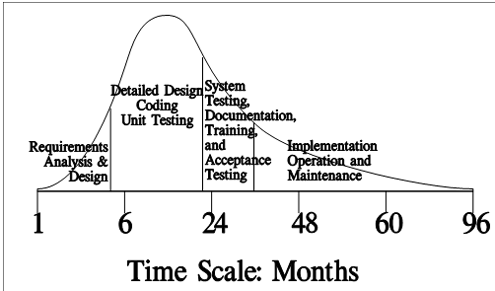
Figure 1
The “problem” may have also significantly changed before the final solution arrives. This is the “hazard” that GAO concludes is intrinsic to the very process. This can
result in perpetual recycling of requirements without ever getting to System Testing.
Beyond the first-cycle implementation cost, the total life cycle expenditure for business information system revision cycles (not shown in Figure 1) commonly costs five times more. The total life
cycle cost is thus 30 times the design cost. The problem, however, is not that requirements change. Rather, the real problem is that the effects of requirement changes that occur once System
Testing et al are complete are too costly to reflect in the implemented business information system.
It must assumed as a given at the very start that requirements will change, even though this assumption is seldom folded into methodologies of today. Requirements changing can be especially fatal
to procured software packages if these packages have not been designed for change from the very beginning.
Because $1 in requirements’ changes causes $29 in additional life cycle costs, the exhortation is simple: Get the requirements right the first time because the cost of change is prohibitive.
The reason the costs are so high and the time is so long is that:
- The tools that either dramatically shorten or even eliminate steps have only recently become demanded.
- Traditional data modeling approaches are employed in preference to the data modeling coupled with prototyping and recycle approach that has been proven.
Only by adopting the suggested techniques and tools can a reduction of 60% or more be realized.
For example, if a data-driven methodology is adopted and is supported by a quality business information system generator, the steps, shown in Figure 1, “Detail Design…,” and
“System Testing…” can be largely eliminated. If a quality Metabase environment is installed that stores and manages all the data models on an enterprise-wide basis, there can be an
improvement in the first phase, Requirements Analysis and Design as well. Finally, if we implement only after four to six design iteration cycles of a prototype, a good bit of the last phase,
Implementation, Operations, and Maintenance can be eliminated.
Quality business information system generators can import a database’s design and generate a working business information system in a few hours. From that first generation, the generated
business information system can be “electronically pruned” to a form that is suitable for demonstration. After several iterations of demonstration, modification, and regeneration, a
quality specification can be created.
The change to the process is illustrated in Figure 2. Shown are four prototype development cycles and one full-implementation cycle. The first “D” (i.e., development) cycle contains the
activities noted (that is, Design, … , Feedback). Each subsequent “D” cycle is dramatically reduced because it only is focused on design changes, regeneration, and the next
demonstration. The first cycle contains a requirements analysis and design step. But, that step is reduced to mainly producing the data model. To arrive at the prototype, the business information
system generator takes in the data model’s design and generates the first-cut business information system. A day or so is then spent to make it “pretty.” Then, the prototype is
demonstrated. In all, only about six weeks will have passed. Each “D” thereafter can occur in one or two weeks. Under this changed approach:
- “Real” business information systems are available to run at the end of every “D” cycle.
- Requirements are iterated until fully known, but are determined in a very condensed time-period.
- Full development occurs only after requirements are completely validated.
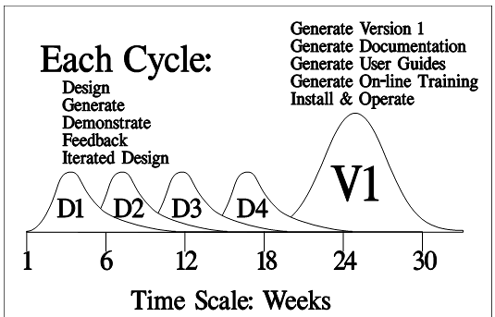
Figure 2
Under either case, the total life cycle cost is the cost of the first cycle plus five times more to account for revisions and extensions.
While over time, the subsequent revisions should cost less, several things happen to thwart that. First, as systems developed through traditional design and coding techniques get “old,”
their designs and program constructions degrade through the application of ad hoc patches and quick fixes. It takes much longer to accomplish maintenance work than new construction work. The result
is the same volume of work.
Second, because of staff turnover, new staff must relearn the system from scratch. That’s almost a complete recycle of the Figure 1 processes. It is both painful and long. In addition,
there’s the “I’d never have done it that way syndrome” to contend with. Every maintenance task seems to get transformed into a fix-and-enhance task. This naturally takes
longer and the enhancement may actually install new bugs.
Third, as new features are required, some of these features are real design breakers. Because a production system has already been implemented, changes take much longer because of redesign,
recoding, and the very tedious and error-prone data conversion.
All the costing is shown in Figure 3. Under the traditional approach, if the first box costs $400,000, the total life cycle costs are 30x, that is, 5 + (5 * 5) or $12 million.
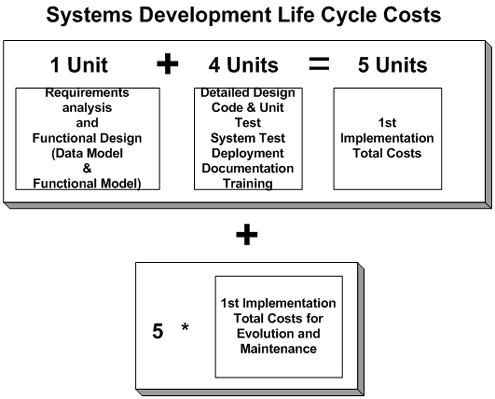
Figure 3
Faced with high costs, the high-pressure demand for immediate and visible results, the most common approach is to trim the first box. Suppose it was trimmed by one-half. In theory then, the total
cost of the first business information system implementation cycle would be reduced to 2.5, that is, 0.5 + (4x 0.5). The total life cycle cost would only be reduced to 15 units, or $6 million.
That’s a 50% savings. Such savings are, however, false.
That’s because the real requirements are still there. The only thing that has changed is that the analysis to discover the real requirements has been reduced by 50%. In short, 50% of the real
requirements are undiscovered.
Now, if the requirements and design efforts are reduced by 50% from 1.0 to 0.5, and given the GAO error allocation of 41% of all information technology errors if this step is underdone or done
wrong, then the “4x” (the amount to accomplish what is really “required”) is likely to be 12x. That is because it’s done wrong, it has to be undone and then done
right. Hence, three times the “4x” number. In that case, the first business information system implementation cycle cost is not the original 5 nor the 2.5, but is 6.5 ( 2.5 (done wrong)
+ 4.0 (now done right) ). The overall life cycle unit quantity becomes 39, that is, 6.5 + (6.5 * 5). This is really a “pay me now or pay me more later” situation. If a unit costs
$400,000, the life cycle cost is now $15.6 million instead of the original $12 million. In short, a requirements analysis of design cut of $200K results in an overall cost increase of $3.6 million.
Clearly, these savings are costly indeed.
For a real impact, the savings must be made to the 4x component (that is, Detailed Design, … , Training). If the 4x component is reduced to 2x, then the life cycle costs are reduced to $7.2
million, that is, 400K * 3 + (400K * 3) * 5. In addition, if due to the business information system generator approach, three of the major business information systems evolution cycles are
eliminated, then the whole life cycle cost is reduced to $3.6 million, that is, 400K * 3 + (400K * 3) * 2. That represents dramatic savings of about 66% from the original $12 million. Now, in
contrast to the $200K savings that cost $3.6 million, these are real savings
Simply, this means that three business information systems can be implemented for the price of one, or that the productivity goes up by 300%. A compelling case. But can it be done? Yes, and this
has been standard best practice for the data-driven Clarion community for the past 20 years. The steps for a quality business information system generator approach are these:
- Import the database design
- Generate a first-cut application
- Electronically prune the first-cut application metadata-based design to the desired behavior model
- Generate the prototype for end-user evaluation
Thereafter, present the prototype to users, gather changes, and repeat the steps above until the users say, “enough already.” Then, and only then, create the production version.
Once the production version is created, there are the evolution and maintenance cycles. The code-generator approach dramatically affects maintenance as well. There were three reasons cited earlier
that cause maintenance to either remain level or take more time under the traditional approach. In contrast to the traditional maintenance approach, under a quality business information system
generator approach, many of the first type of evolution and maintenance problems are eliminated outright. The second type of evolution and maintenance problem is of course, unavoidable, but because
90% or more of any business information system’s code is generated, it does not have to be learned. In fact, because the ultimate program’s code sort of doesn’t really exist, it
never has to be addressed at all.
Quality business information system generators operate at a meta-design level. The actual program code is generated from this meta-design level. Changes are made at the meta-design level as well.
So, once the changes are made, the ultimate code is regenerated. If it wasn’t necessary to deal with real code at first, there is no need now. Finally, the third type of evolution and
maintenance problem largely disappears because there are four or more design iterations before first implementation. The five cycles of maintenance caused by an immature design are eliminated
because the design has matured through prototyping before it is implemented.
Summary
There is no down-side to the adoption of this 9-step approach. The overall information technology organization and the functional organizations that are supported by this approach are more
productive, less costly, higher quality, and lower risk because more work is done in a non-redundant, integrated manner. More work products are able to be re-used because they are created with
re-use in mind, stored in a metadata format, and reside in a multiple-user Metabase that has an enterprise-wide perspective. Data semantics are able to be harmonized which eliminates whole classes
of data transformation and reloading business information systems and logic. Again, there is no downside to adoption provided doing more faster at a lower cost and lower risk are the objectives.
The U.S. Army uses a starter slide for many of its briefings. The slide’s header contains the string, “BLUF.” Here’s this article’s BLUF. With this approach, you can
both save at least 40% on all your business information systems’ development, but also you can create these business information systems within an enterprise-data framework. As stated many
times, there is no downside to this approach. It is squarely based on database’s first principle: Define once, use many-times. That’s this article’s BLUF. In the Army, BLUF means:
Bottom Line Up Front.
It is hoped that careful consideration will be given to this approach and that it will be applied to bring about some reality to the myth of data processing. That is, all things in a blink of an
eye. If you are a member of a project team, accomplish the article’s strategies. When you are successful and your manager wants to know why, have him/her read the article. If you are a
project manager, make sure your project adopts the methods in this article so you can have a positive impact on your organization. When your boss notices and asks what you are doing differently,
give him/her the article to read. In short, keep passing this article to higher levels in your organization until enterprise-wide changes in the business information system development are
accomplished.
